
Curious how your lifestyle and health affect your odds? This advanced calculator lets you add details like age, BMI, and more for a more detailed pregnancy chance estimate.
How to Use the Advanced Pregnancy Chance Calculator
Using our advanced calculator is easy, and the more information you provide, the more detailed and personalized your pregnancy estimate will be.
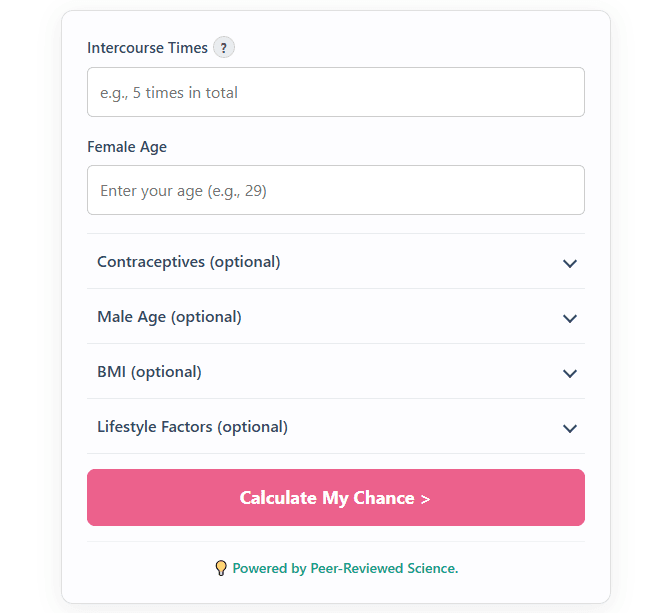
Simply enter your details and press the “Calculate” button to get your results.
This calculator estimates your chance of pregnancy over a real or hypothetical time period, using factors that influence fertility in the real world.
Your privacy is important, and we do not store your calculator answers in a database or use them for advertising.
🔍 Input Fields Explained
- Contraceptive Methods (optional):
Select up to two contraceptive methods if you used protection. You can also choose “No contraceptive” if none were used.
➡️ Want to know how method use quality affects your risk?
Read: Contraceptive Use Quality – Perfect vs Imperfect - Perfect Use?
Select “Yes” if you used the method exactly as instructed every time (no missed pills, no condom mishaps, etc.).
Select “No” if there were any mistakes or inconsistency. - Intercourse Times:
Enter the number of times you had intercourse during the selected period (e.g., 50). The more frequent, the higher the pregnancy likelihood. - Female Age:
Age directly affects fertility. Enter the female participant’s age during the time period (e.g., 37). - Male Age:
Male fertility also declines with age. Enter the male participant’s age (e.g., 39). - Female Height & Weight:
These are used to calculate BMI, which impacts fertility. Input height (in ft/in or cm) and weight (in lbs or kg). - Work Hours per Week:
Enter your average weekly work hours (e.g., 25). High workloads can correlate with stress, which may affect fertility. - Daily Cigarettes:
Enter the average number of cigarettes smoked per day (e.g., 5). Smoking is a well-known fertility risk factor. - Weekly Alcohol Intake:
Input how many standard alcoholic drinks you consume per week (e.g., 3). Alcohol can influence reproductive health in both men and women.
How It Works
This calculator combines published background data with the details entered to provide a planning estimate.
The result is a statistical planning estimate. It cannot account for every fertility factor or predict an individual outcome.
The sources below support broad relationships used by the calculator. They provide background context for the planning estimate. Individual outcomes can vary.
➡️ Learn more about how our calculator works, including the research behind it.
The Science Behind Our Advanced Pregnancy Chance Calculator
Pregnancy chance can vary with timing, age, contraceptive use, and other health or lifestyle factors. The calculator uses the details entered to provide a planning estimate.
The Advanced Pregnancy Chance Calculator uses multiple inputs to produce a broad planning estimate. It is not a medical assessment of personal fertility.
How the Advanced Calculator Works
1. Intercourse Frequency
Intercourse timing and frequency both matter. ASRM guidance says intercourse every 1 to 2 days during the fertile window gives the highest pregnancy rates, while results from intercourse 2 to 3 times per week are nearly equivalent.
Fertility tracking can help identify the fertile window, but no home method predicts ovulation perfectly. The calculator therefore treats timing and frequency as estimates rather than proof of when ovulation occurred.
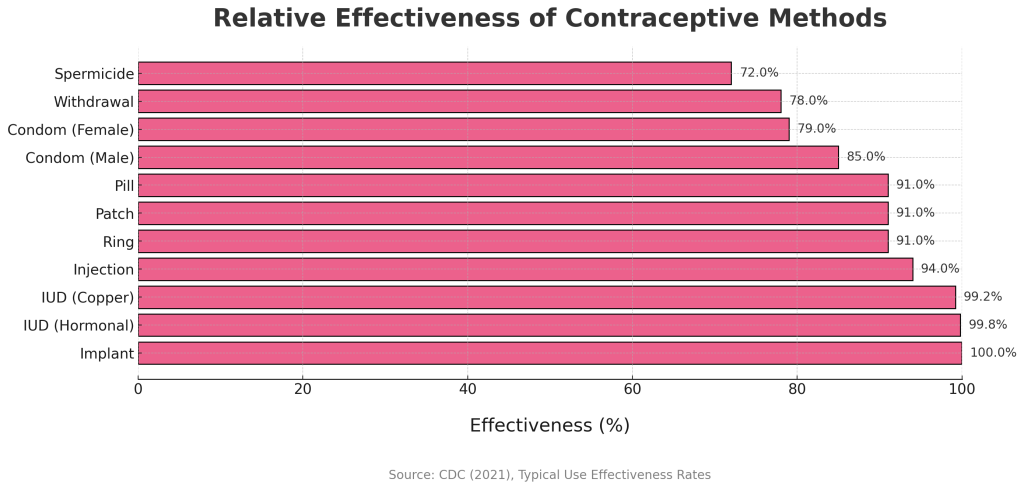
2. Contraceptive History and Use Quality
If you’ve used contraception recently or inconsistently, your pregnancy chances are affected. Our tool considers:
- Contraceptive method used
- Whether it was used with perfect or typical consistency
This is key, since imperfect contraceptive use - like missed pills or condom mishaps - can substantially increase pregnancy risk.
📚 Learn more about contraceptive effectiveness and use quality here.
3. Age and Fertility
Fertility naturally declines with age, and our calculator adjusts for this:
- Female Age: Fertility begins to decline in the early 30s, with a sharp drop after 35, largely due to reduced egg quality and quantity.
- Male Age: A systematic review and meta-analysis found age-related declines in several semen measures. The size and personal effect vary, so the calculator uses male age only as a broad factor.
4. Lifestyle Factors That Affect Fertility
The calculator includes several lifestyle inputs as broad contextual factors. The cited observational evidence shows associations, not a guaranteed effect for one person:
- Smoking: In one observational study, smoking above the studied threshold was associated with longer time to pregnancy.
- Alcohol Consumption: The same study found longer time to pregnancy when the male partner reported more than 20 alcohol units per week. It does not establish the effect of every drinking level.
- Work Hours & Stress: This input adds context to the planning estimate. The calculator uses this information as context within the overall estimate.
5. Body Mass Index (BMI)
The calculator uses height and weight to estimate BMI. In one observational study, BMI above the studied threshold was associated with longer time to pregnancy. BMI is used as context within the overall estimate.
📊 Where Does Our Data Come From?
These references provide background data used by the calculator. They provide background evidence for these inputs:
- Contraceptive Effectiveness:
- Trussell, J. (2011) – Contraceptive failure in the U.S.
- Kost, K. et al. (2008) – National Survey of Family Growth
- Intercourse Frequency Data:
- Twenge, J. M., et al. (2017) – Descriptive U.S. sexual-frequency data; not a study of conception rates
- Age and Fertility:
- Wesselink, A. K., et al. (2017) – Female age and per-cycle conception probability in a North American preconception cohort
The calculator combines these sources with the inputs provided to produce a planning estimate.
Try It Now: Estimate Your Pregnancy Chances
The advanced calculator uses intercourse frequency, contraceptive use, age, lifestyle, and BMI to produce a broad planning estimate.
👉 Get your personalized estimate today:
🔗 Use the Advanced Pregnancy Chance Calculator
Medical disclaimer
The information and calculators on this site are educational tools only. They provide statistical estimates based on published research and the details you enter.
They cannot diagnose, predict what will happen for you, or replace personalized advice from a licensed health care professional who knows your full history. Always talk with your doctor, midwife, or other qualified clinician before making decisions about your health, fertility, or pregnancy.
Never ignore, avoid, or delay seeking professional medical advice because of something you read here or a result you see in a calculator. If you think you may be having a medical emergency, call 911 in the United States or your local emergency number.