
Reviewed by Dr. Grace Ramosena, MBChB on Jan 25, 2026
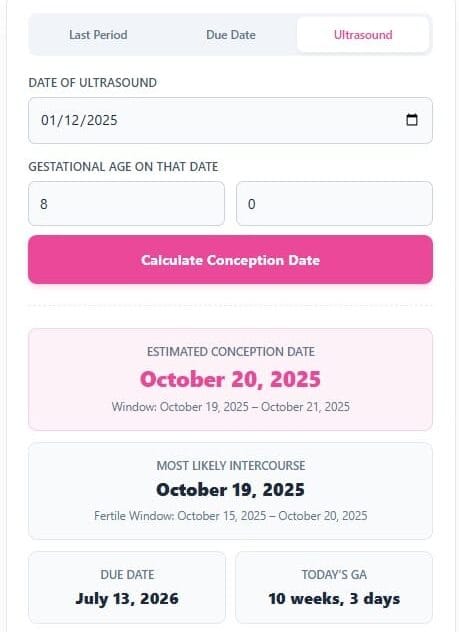
Enter LMP, due date, or ultrasound to estimate your conception date and likely intercourse window. We also show a timeline of key pregnancy dates.
*Actual conception may fall outside the displayed dates. These ranges are not a measure of dating accuracy and cannot identify which intercourse event led to pregnancy or establish paternity. Long or irregular cycles add uncertainty.
How to Use This Calculator
This tool offers three standard clinical dating methods to reverse-engineer your conception date. Choose the one that matches the information you have available.
1. Choose Your Method
Select the tab at the top of the calculator:
- Last Period (LMP): An okay method if you have regular cycles and know the first day of your last period.
- Due Date: A good method if your doctor has already given you an Estimated Due Date (EDD).
- Ultrasound: The most accurate method if you have early scan results (e.g., "8 weeks and 3 days").
2. Enter Your Details
- For LMP: Enter the first day of your last period and your average cycle length (default is 28 days).
- For Due Date: Simply pick the date from the calendar.
- For Ultrasound: Enter the date the scan was performed, then the gestational age (Weeks and Days) recorded on that report.
3. View Your Timeline
Click "Calculate Conception Date" to see your estimated date of conception, your most fertile intercourse window, and your current gestational age.
The Science: Three Paths to the Same Date
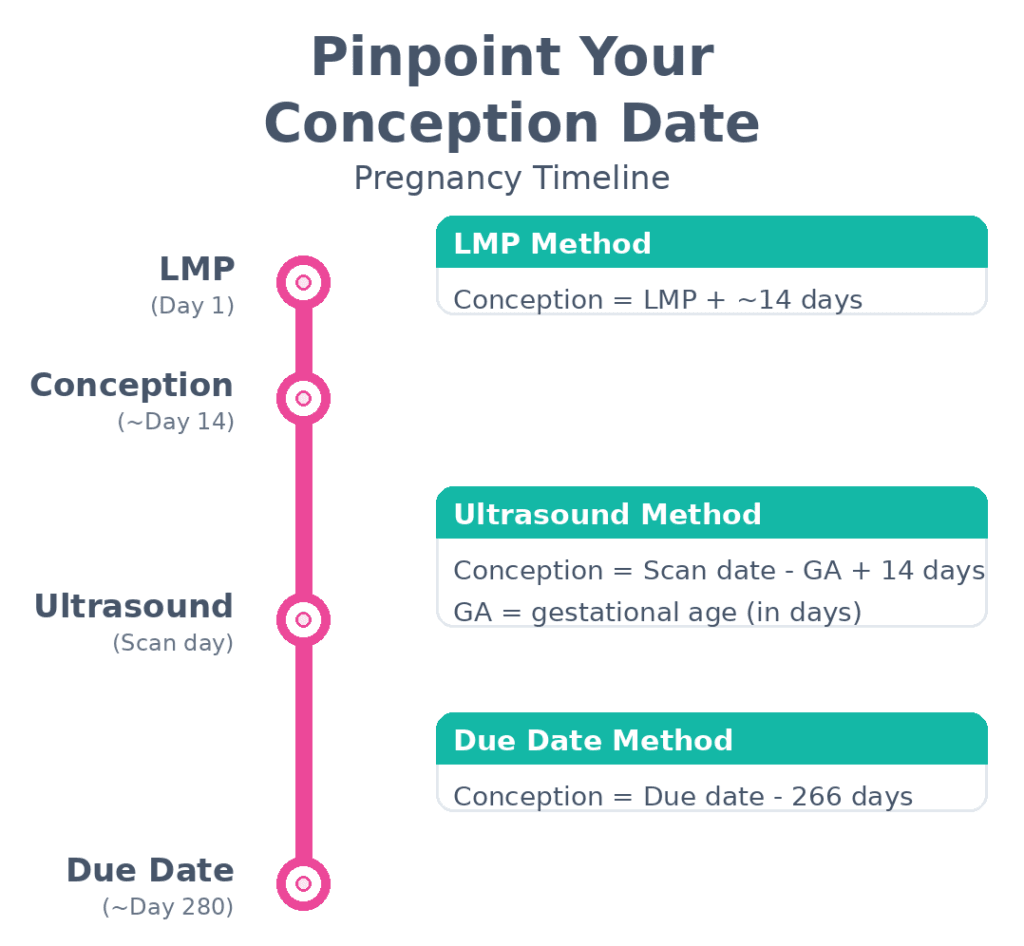
While it feels like there should be one simple answer, your conception date is calculated differently depending on the data you start with. As the timeline below illustrates, all methods work by navigating the fixed relationship between your Last Menstrual Period (LMP), your ovulation, and your due date.
1. From Last Menstrual Period (LMP)
This is the most common method. We start with the first day of your LMP (Day 1) and adjust for your unique cycle length. For a standard cycle, conception typically occurs around Day 14, coinciding with ovulation.
2. From Due Date
This is a reverse calculation. A standard pregnancy is considered 280 days long. To find when it started, we count backward 266 days (38 weeks) from your Due Date to estimate the date of fertilization. Your estimate carries the uncertainty of the due date used.
3. From an Ultrasound
Often the most reliable method in the first trimester, an ultrasound measures the baby's size to determine "Gestational Age." We use that age to calculate the pregnancy's clinical start date, then add approximately 14 days to estimate when conception occurred.
Frequently Asked Questions
Which calculation method is the most accurate?
An early first-trimester ultrasound is widely considered the most reliable method. If you have scan data (e.g., "8 weeks 3 days"), use the Ultrasound tab above for the best result. If you don't have a scan yet, the LMP method is the standard starting point.
Can this calculator tell me the exact day I had intercourse?
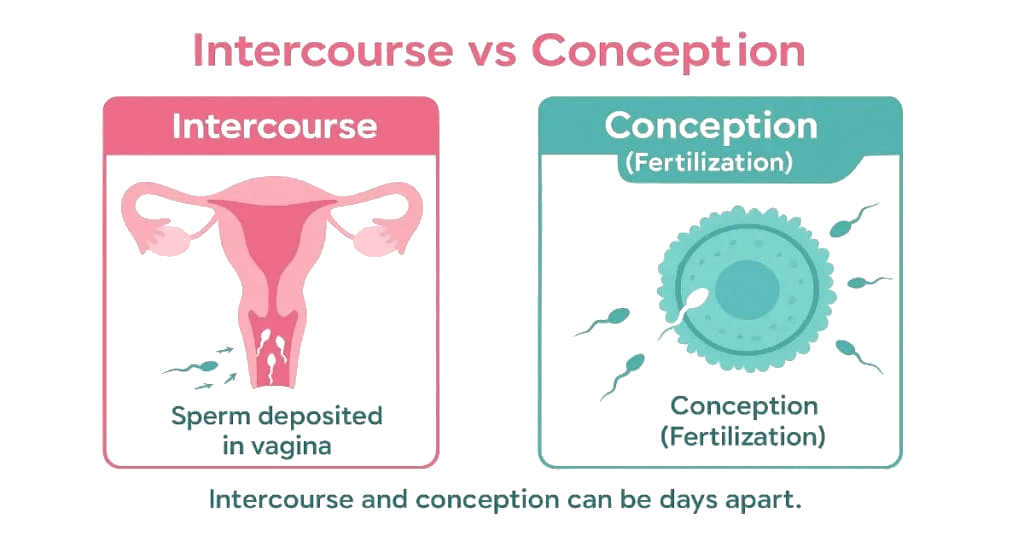
No. Intercourse can occur several days before fertilization because sperm can survive for up to 5 days. The displayed window is based on estimated ovulation, which may differ from the actual date. The single date shown is the day before estimated ovulation; it does not identify when you had intercourse.
Can this determine paternity?
No. These date estimates cannot establish paternity or reliably exclude a possible father. Uncertainty in ovulation and pregnancy dating can shift the displayed window. DNA testing is needed to determine biological paternity.
Why does my cycle length matter?
Most simple calculators assume a 28-day cycle with ovulation on Day 14. If your cycle is 32 days, you likely ovulated around Day 18. If we didn't adjust for this, your estimated conception date could be off by nearly a week.
Is conception the same as implantation?
No. Conception is the moment the sperm fertilizes the egg. Implantation happens when the fertilized egg burrows into the uterine lining, usually 6–12 days later. You can estimate that specific date with our Implantation Calculator.
I did IVF. Does this calculator work for me?
If you conceived via IVF, "LMP" dating is often inaccurate. Instead, you should calculate based on your Transfer Date (Day 3 or Day 5). Your conception date is technically the day of fertilization (retrieval), which occurred before the transfer.
Methodology and Sources
Purpose of this Tool
This calculator works backward from your period, due date or scan to estimate conception and intercourse timing. The displayed dates are approximate. The narrow range around conception is not a confidence interval, and the intercourse window assumes the estimated ovulation date is correct.
1. The Math Behind the Estimate
Depending on the data you enter, we use one of three standard clinical formulas to reverse-engineer the conception date.
A. If you use Last Menstrual Period (LMP)
Standard obstetric dating assumes ovulation occurs 14 days before the next expected period. We adjust this based on your cycle length.
- The Formula:
Conception Date = LMP + (Cycle Length - 14 days) - Example: If your cycle is 28 days, we estimate conception on day 14. If your cycle is 32 days, we estimate it on day 18 (because the first phase of the cycle is longer).
B. If you use Due Date (EDD)
We use the standard "266-day rule" widely accepted in obstetrics.
- The Formula:
Conception Date = Due Date - 266 days - Why 266? A full-term pregnancy is traditionally counted as 280 days from the LMP (40 weeks). Since conception typically happens 2 weeks after the LMP in a standard cycle, the actual fetal age is 2 weeks less (280 - 14 = 266).
C. If you use Ultrasound (Scan Date)
Early ultrasounds (before 13 weeks) are the most accurate way to date a pregnancy. We calculate the "Clinical Start Date" (LMP equivalent) from the scan, then find conception relative to that.
- The Formula:
Conception Date = Scan Date - (Gestational Age in Days - 14) - Gestational age is counted from an LMP-equivalent date, about two weeks before estimated conception. A scan dates the pregnancy; it does not identify the exact day of conception.
2. Biological Windows (Intercourse vs. Conception)
While "conception" happens at a specific moment (fertilization), the sexual intercourse that led to it could have happened days earlier. This calculator distinguishes between the two based on sperm viability.
- Conception Window (24 hours): The egg is viable for only about 12–24 hours after ovulation. If it is not fertilized in this window, it disintegrates.
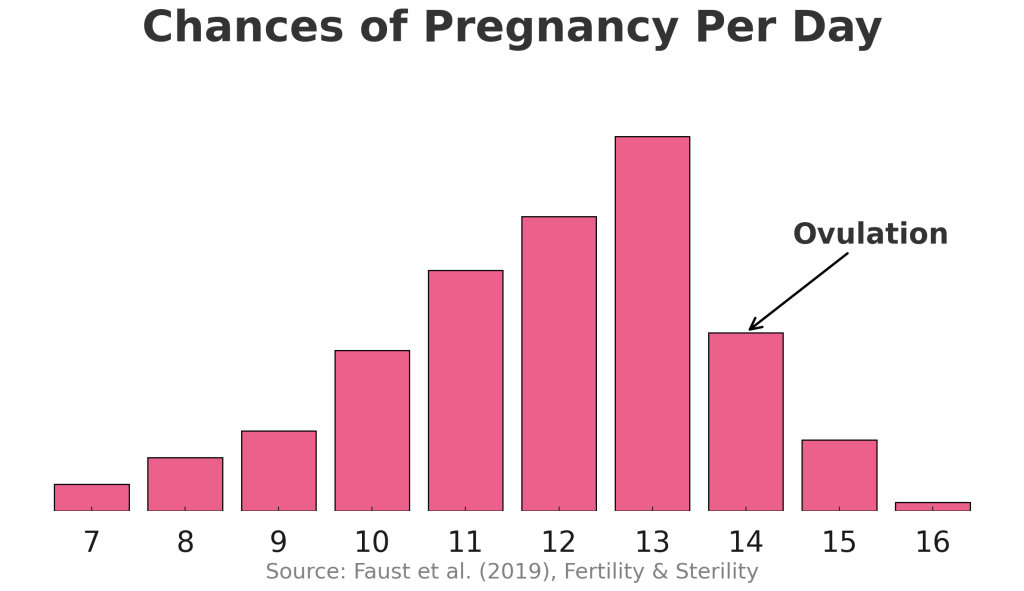
- Intercourse Window (6 days): Sperm can survive in fertile cervical mucus for up to 5 days before ovulation. Therefore, intercourse on any of the 5 days leading up to ovulation—or the day of ovulation itself—can result in pregnancy.
The single intercourse reference date is one day before estimated ovulation. It is not a calculated personal likelihood or evidence of which intercourse event led to pregnancy.
3. Accuracy and Limitations
Biology rarely follows a perfect schedule. Even in regular cycles, the day of ovulation can vary by a few days from month to month.
- Standard Variation: This tool assumes a constant luteal phase (the time from ovulation to period) of 14 days. In reality, this can range from 10 to 16 days.
- Ultrasound Margin of Error: Early scans have a margin of error of ±5–7 days.
- Paternity: This tool estimates dates, not paternity probabilities. Do not use its dates to confirm or exclude a possible father.
Sources
The logic used in this tool is informed by the following clinical guidelines and research:
- American College of Obstetricians and Gynecologists (ACOG). Method for Estimating Due Date. Committee Opinion No. 700. May 2017. View Source
- Wilcox AJ, Weinberg CR, Baird DD. Timing of sexual intercourse in relation to ovulation. New England Journal of Medicine. 1995;333(23):1517-21. (Establishes the 6-day fertile window). View Source
- Morgan JA, Cooper DB. Pregnancy dating. StatPearls [Internet]. Treasure Island, FL: StatPearls Publishing. Summary of clinical methods for pregnancy dating and due date estimation. View chapter.
Disclaimer: This tool is educational and does not replace professional medical advice. Always consult your doctor or midwife for personal pregnancy dating.
Medical disclaimer
This calculator is an educational tool. It provides approximate dates based on pregnancy dating conventions and the details you enter.
This calculator cannot diagnose, predict what will happen for you, or replace personalized advice from a licensed health care professional who knows your full history. Always talk with your doctor, midwife, or other qualified clinician before making decisions about your health, fertility, or pregnancy.
Never ignore, avoid, or delay seeking professional medical advice because of something you read here or a result you see in a calculator. If you think you may be having a medical emergency, call 911 in the United States or your local emergency number.