
Reviewed by Dr. Sony Sherpa, MBBS, MD on Dec 22, 2025
Use this calculator to estimate twin odds for one pregnancy. Use the Optional details section to explore factors associated with natural twinning.
*IVF figures compare twin pregnancies in one fresh-blastocyst study; they are not personal predictions. Other treatment bands are illustrative. Ultrasound confirms whether a pregnancy is twins.
Key points
- Fraternal (dizygotic) twins happen when two eggs are fertilized. Their odds vary with factors like maternal age, family history on the maternal side, prior pregnancies, height/BMI, ethnicity, and fertility treatment.
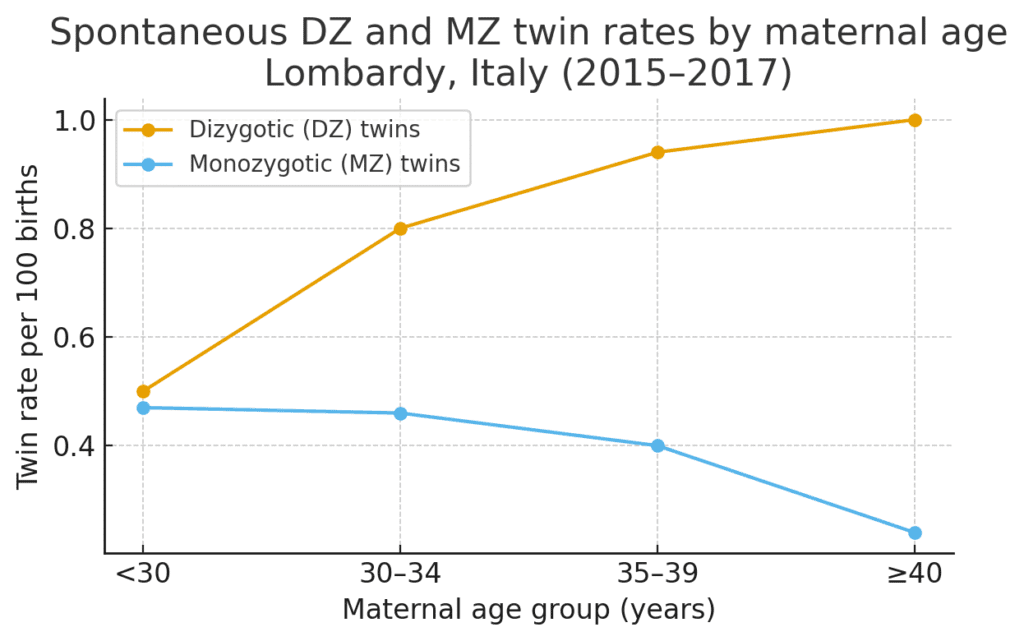
- Identical (monozygotic) twins come from one embryo splitting. Rates are relatively stable across groups and are less influenced by age or family history.
- Single-embryo transfer (SET) in IVF lowers twin odds; transferring multiple embryos increases twin odds.
- Your result is a population-based estimate. Only ultrasound can confirm twins.
What affects the odds?
- Maternal age: Twin rates (especially fraternal) tend to rise through the early–mid 30s.
- Maternal family history: A mother with female relatives who had fraternal twins may have higher odds.
- Parity/prior twins: Previous pregnancies - and especially previous fraternal twins - are linked with higher odds.
- Body size: Taller body size and higher BMI have been associated with more fraternal twinning.
- Ethnicity: Twin rates differ by population in published registries.
- Fertility treatment: Ovulation-inducing meds and transferring multiple embryos can raise twin odds. Discuss embryo-transfer policies with your clinic.
Important: None of these factors “cause” twins on their own. They shift probabilities only.
FAQ
Do identical twins run in families?
Identical twinning is mostly random and not strongly tied to family history. Fraternal twins are the type more associated with maternal family history.
Does IVF always mean twins?
No. Many clinics recommend single-embryo transfer (SET). Twin likelihood depends on your clinic’s protocol and number of embryos transferred.
Can high hCG prove twins?
Higher hCG can occur with twins but is not diagnostic. Only ultrasound can confirm twins.
Do twins skip a generation?
That’s a myth. What matters most for fraternal twinning is ovulation of multiple eggs - which can run on the maternal side.
Methodology and sources
What this estimates
This calculator estimates the chance that a single pregnancy will be twins. It does not estimate your chance of getting pregnant or your chance of twins across your whole life.
Natural twin chance
The model starts with an average chance of twins in naturally conceived pregnancies. This is split into two parts: fraternal twins (dizygotic, DZ) and identical twins (monozygotic, MZ). The DZ baseline is set at about 1.2 percent of pregnancies. The MZ baseline is set at about 0.35 to 0.4 percent of pregnancies, which is fairly stable worldwide and mostly does not depend on age or family history.
Factors that adjust the DZ chance
The DZ part of the risk is then adjusted up or down using published research. The main factors are:
- Maternal age: DZ twins are most common in the early to mid 30s. The calculator increases the chance in that age range and lets it drop again in the late 30s and 40s.
- Prior births (parity): Having had several previous births slightly raises DZ twinning rates. The effect is capped so it does not grow without limit at very high parity.
- Maternal family history: A history of twins on the mother's side suggests a tendency to release more than one egg. The calculator raises the DZ chance if this is present.
- Height and body mass index (BMI): Taller height and higher BMI are linked with somewhat higher DZ twinning rates. Shorter stature and very low BMI are linked with slightly lower rates.
- Ethnicity group: Some population groups have naturally higher or lower DZ rates than the global average. The model nudges the DZ chance up or down to reflect these patterns.
- Previous twins: Having had spontaneous twins before is a strong signal of higher DZ chances in future pregnancies, so this factor is given extra weight.
The MZ part of the risk is kept almost constant, because identical twins usually happen at a low background rate that is less affected by these factors.
Fertility treatment scenarios
IVF results show a study comparison, not a personal prediction. In Friedman and colleagues’ study, twins occurred in 1 of 62 pregnancies after elective single blastocyst transfer (about 1.6%) and 65 of 207 after double blastocyst transfer (about 31%). The twin-only double-transfer figure excludes two pregnancies that initially had triplets. The denominator is pregnancies seen on ultrasound, not all transfers or live births.
This was a single-center study of fresh, non-donor IVF in patients with extra blastocysts available to freeze. These figures remain fixed when you change age or personal details. They do not provide a clinic-specific estimate for frozen transfers, donor eggs or other protocols. Your clinic can estimate risk using your embryos and treatment plan.
Ovulation induction and stimulated IUI retain rough treatment scenarios that adjust for age and the natural estimate. Drug choice, follicle count and cancellation policy matter; these options do not distinguish individual protocols. Their illustrative band is 20% below and above the estimate, not a measured typical range or confidence interval. Studies reporting twins together with triplets cannot directly establish a twins-only rate.
How the model combines factors
For natural conception, the calculator multiplies the DZ baseline by age, parity, family history, height, BMI, ancestry and prior-twin factors, then adds the MZ baseline. These associations do not establish the accuracy of the combined estimate for an individual. The natural comparison remains separate from the fixed IVF study figures.
Missing or average values
If height or weight are left blank, the calculator uses average values. This mainly affects the BMI adjustment and usually only changes the final percentage by a small amount.
Limits of the estimate
This model uses population averages. It cannot account for details such as exact drug doses, embryo quality, embryo stage, genetic testing, clinic policies, or specific health conditions. Real world twin rates for you and your clinic may be higher or lower than the estimate.
Disclaimer
This tool is for general education only and is not medical advice. It does not replace counselling with your fertility specialist or maternity care team. Always discuss your own situation and risks with your clinician.
IVF comparison source
Friedman et al. Single versus double blastocyst transfer, 2011. See also ASRM’s review of blastocyst transfer.
Main sources
Key references include large studies of global twinning patterns, reviews of factors that affect fraternal twinning, and trials and registry data on multiple pregnancy rates with fertility treatment, such as:
- Monden C, Smits J, Pison G. Twin Peaks: more twinning in humans than ever before Human Reproduction, 2021. (Comprehensive global study on twinning rates by region).
- J Fellman, A W Eriksson Variations in the maternal age effect on twinning rates: the Nordic experience Twin Research, 2005.
- Hoekstra C, et al. Dizygotic twinning. Human Reproduction Update, 2008. (Review of factors like height, BMI, and genetics).
- Reddy U M, et al. Relationship of maternal body mass index and height to twinning. Obstetrics and Gynecology, 2005.
- Diamond MP, Legro RS, et al. Letrozole, Gonadotropin, or Clomiphene for Unexplained Infertility New England Journal of Medicine, 2015.
- P Parisi, M Gatti, G Prinzi, G Caperna https://pubmed.ncbi.nlm.nih.gov/6683788/ Nature, 1983.
Medical disclaimer
The information and calculators on this site are educational tools only. They provide statistical estimates based on published research and the details you enter.
They cannot diagnose, predict what will happen for you, or replace personalized advice from a licensed health care professional who knows your full history. Always talk with your doctor, midwife, or other qualified clinician before making decisions about your health, fertility, or pregnancy.
Never ignore, avoid, or delay seeking professional medical advice because of something you read here or a result you see in a calculator. If you think you may be having a medical emergency, call 911 in the United States or your local emergency number.