
Get an instant estimate of your chance of pregnancy, based on published research and the details you enter.
Calculating your result and calendar…
How to Use Our Calculator
- Enter the number of intercourse events you want to estimate for (any time frame).
Only one event? Try the One-Time Calculator. - Enter your age (optional).
- Choose a contraceptive method (optional) - leave as “No contraceptive” if none was used.
- For a more accurate result, use the 'Advanced Settings' inputs. The more you use, the more precise our estimate will be.
- Press Calculate
We don’t store your inputs. Results are estimates and show a capped range (never exactly 0% or 100%).

How Our Calculators Work: The Science Behind Your Estimate
This calculator combines published data on contraceptive effectiveness, fertile-window timing, age, and lifestyle associations with the details you enter to provide a planning estimate. The sources explain the background evidence used for this planning estimate. Individual outcomes can vary.
The result is a statistical estimate. It cannot account for every fertility factor or predict what will happen for one person.
The Key Factors in Our Algorithm
Female Age
A primary driver of fertility. Our model accounts for the natural decline in egg quantity and quality over time, based on guidelines from the American College of Obstetricians and Gynecologists (ACOG).
Male Age
Male age is included as a broad factor. A systematic review and meta-analysis found age-related declines in several semen measures, although this does not predict an individual partner’s fertility.
Intercourse Timing
We account for intercourse timing and frequency. ASRM guidance says intercourse every 1 to 2 days during the fertile window gives the highest pregnancy rates, while 2 to 3 times per week is nearly equivalent.
Body Mass Index (BMI)
BMI is used as a broad contextual factor. In one observational study, BMI above the studied threshold was associated with longer time to pregnancy. The calculator uses this information as part of the overall planning estimate.
Lifestyle Factors
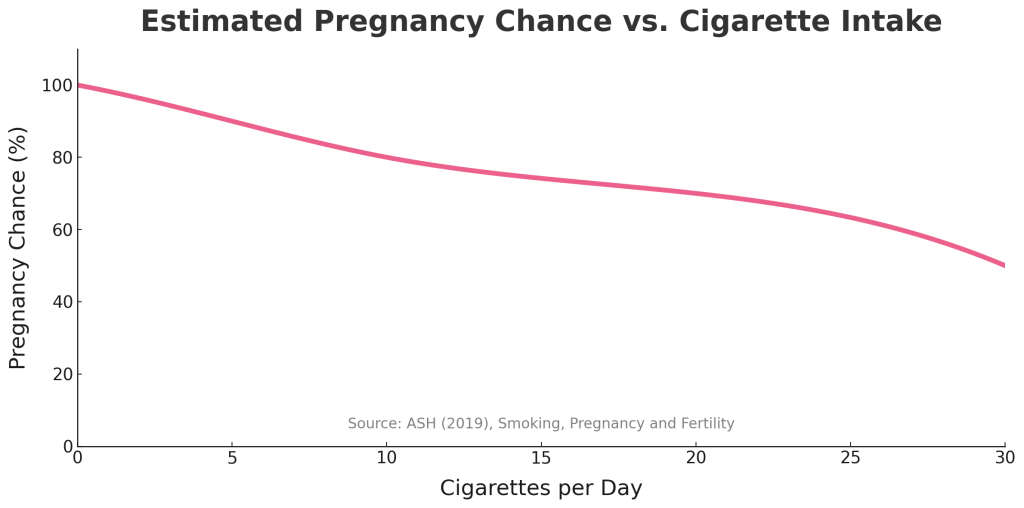
Smoking and alcohol are treated as broad contextual factors. An observational study found longer time to pregnancy at the smoking and partner-alcohol levels it examined.
Contraceptive Use
We use large-scale study data, including the landmark Trussell (2011) study on contraceptive failure, to factor in typical and perfect-use rates.
Foundational Data Sources & Primary Research
- Contraceptive failure rates: Trussell 2011; Kost et al. 2008
- Age & fertility: Wesselink et al. 2017
- Intercourse timing and frequency: ASRM natural-fertility guidance
For more of the published background sources used across the site, visit our Research Library.
Frequently asked questions
How many days after my period will I conceive?
When is the 100% chance of getting pregnant?
How can I be sure I ovulated?
How reliable is the withdrawal method?
How long can sperm live in the body?
Can I use this if my cycles are irregular?
Does breastfeeding change my chances?
Medical disclaimer
The information and calculators on this site are educational tools only. They provide statistical estimates based on published research and the details you enter.
They cannot diagnose, predict what will happen for you, or replace personalized advice from a licensed health care professional who knows your full history. Always talk with your doctor, midwife, or other qualified clinician before making decisions about your health, fertility, or pregnancy.
Never ignore, avoid, or delay seeking professional medical advice because of something you read here or a result you see in a calculator. If you think you may be having a medical emergency, call 911 in the United States or your local emergency number.