
Trying to estimate a due date from a specific event? Enter an intercourse date or estimated conception date to get a useful timeline, including likely LMP, gestational age, and pregnancy milestones.
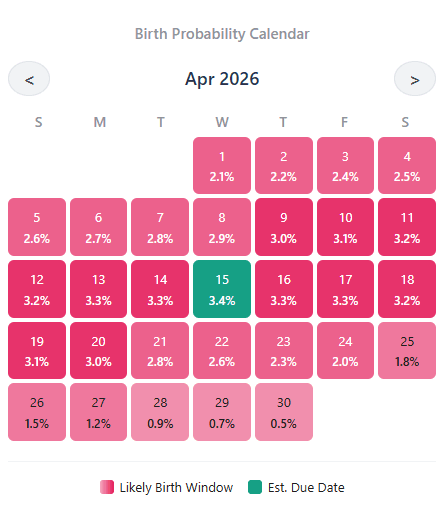
Illustrative Birth Timing Calendar*
Pregnancy Progress
Current Status
Key Dates
*The intercourse method assumes conception two days later. Calendar percentages illustrate timing; they are not your personal birth odds. Use your clinician’s due date for pregnancy care.
How the intercourse-date estimate works
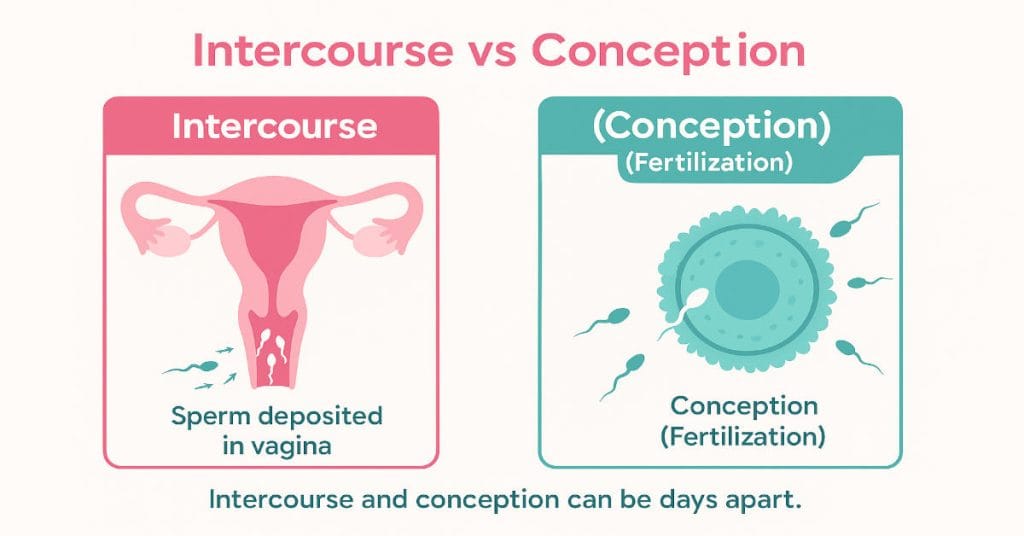
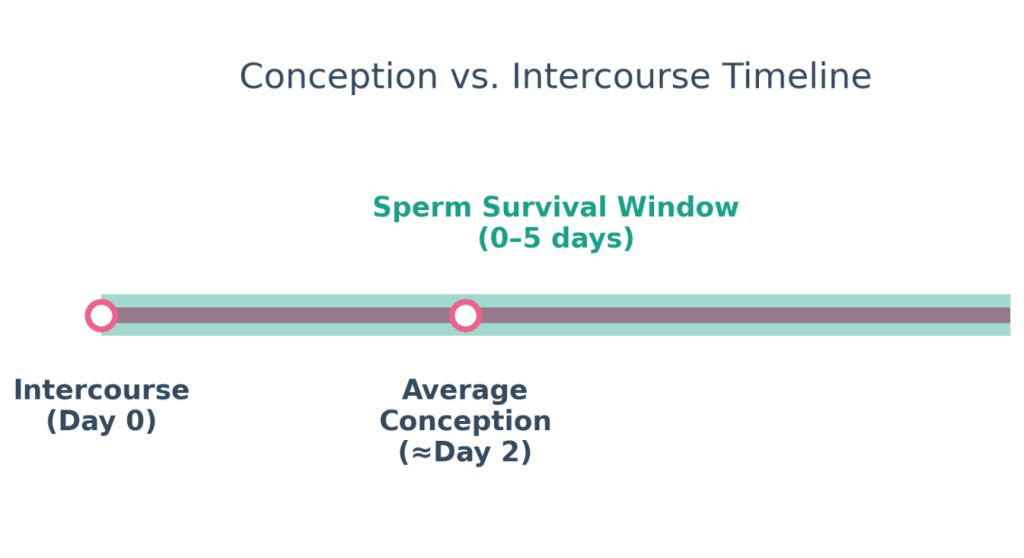
Intercourse and conception can happen on different days. Sperm can survive for up to five days, so an intercourse date alone cannot identify the day of conception.
For the intercourse-date method, this calculator assumes conception two days later, then adds 266 days. This is a planning approximation; it has not been shown to be more accurate than other dating methods.
If you prefer to work from your last menstrual period instead of an intercourse date, use our main baby due date calculator.
How to Use This Calculator & Read Your Results
Our tool is designed to be simple to use and provide a rich, detailed timeline. Here’s how to get your results in just a few steps.
- Choose Your Method: Select whether you know your Intercourse Date (the default) or your Conception Date using the toggle at the top.
- Enter Your Date: Click the input field and use the calendar to select the specific date you have in mind.
- Calculate Your Timeline: Click the "Calculate Due Date >" button.
- Explore Your Results: Your full, personalized timeline will appear, including your estimated due date, pregnancy progress, and the interactive Illustrative Birth Timing Calendar.
Understanding Your Illustrative Birth Timing Calendar
Birth can happen before or after the estimated due date. The calendar illustrates a spread of possible timing around that date; it does not predict your delivery day.
- The Colors: The calendar uses a color gradient to show the Illustrative Timing Window. Lighter pink shades indicate smaller shares, while the vibrant, darker pinks highlight the largest shares of the illustrative curve.
- The Percentages: Each day in the window shows a percentage. This is that day’s share of an illustrative timing curve, not your personal chance of giving birth that day.
- The Due Date: The green square marks your Est. Due Date. The illustrative curve is centered on this date; it does not establish your most likely delivery day.
The Science: From a Single Day to a Full Timeline
The conception-date method adds 266 days. The intercourse-date method first adds an assumed two-day interval. Your clinician may refine your due date using your history and ultrasound findings.
- If you enter a Conception Date: This is the most direct method. We simply add 266 days (38 weeks) - the standard length of a pregnancy from conception to birth - to find your estimated due date.¹
- If you enter an Intercourse Date: We estimate your conception date to be approximately 2 days after intercourse. From that estimated conception date, we then add 266 days to calculate your final due date.
Frequently Asked Questions
Which input method should I use?
Use a conception date if it is known; otherwise an intercourse date gives a rough planning estimate. For IVF, use a transfer-date calculator that accounts for embryo age. Your clinician’s pregnancy dating should guide care.
What if I had intercourse on multiple days?
You can try each date to compare estimates. Choosing the earliest date does not necessarily make the estimate more accurate, and this calculator cannot identify which intercourse event led to pregnancy.
Why shouldn't I just add 280 days to my intercourse date?
This is a common mistake. The 280-day (40-week) pregnancy length is measured from your Last Menstrual Period (LMP), not from intercourse or conception. Calculating from conception requires using the fetal age of 266 days (38 weeks), which our tool does automatically.
What if I don't know my intercourse or conception date?
No problem! Our main Due Date Calculator allows you to calculate your due date from your Last Menstrual Period (LMP), which is the most common and reliable method for most people.
Methodology and sources
What this calculator estimates
This tool assumes that a pregnancy has already started and uses either an intercourse date or a conception date to estimate:
- an estimated due date (EDD),
- current gestational age and trimester,
- a simple fetal size estimate, and
- an illustrative birth timing calendar around the due date.
It does not predict whether pregnancy will occur from a given act of intercourse.
Obstetric dating rules used
Standard obstetric dating counts gestational age from the first day of the last menstrual period (LMP). A typical pregnancy is treated as about 280 days from LMP and about 266 days from conception. The calculator follows the same convention:
- If you enter a conception date, the tool sets a “clinical LMP” 14 days earlier and sets the due date 266 days after conception (equivalent to LMP + 280 days).
- If you enter an intercourse date, the tool assumes conception happens 2 days later as a planning approximation, then applies the same 266-day interval from that estimated conception date.
The 266-day conception-to-due-date interval follows standard dating conventions. The two-day intercourse-to-conception interval is an approximation, not a clinical rule for an individual pregnancy.
Gestational age and pregnancy progress
Once the clinical LMP is set, gestational age today is calculated as the number of whole days between that LMP date and today. The tool then:
- converts days to weeks and extra days for the “weeks into pregnancy” field,
- classifies trimester as:
- First trimester: up to 12 weeks 6 days,
- Second trimester: 13 weeks to 26 weeks 6 days,
- Third trimester: 27 weeks and beyond,
- computes “percent complete” as days since clinical LMP divided by the total days between clinical LMP and the due date, capped between 0 and 100 percent.
Fetal length and weight estimates
The fetus length and weight numbers are approximate averages. The calculator uses a smoothed look-up table of typical crown–rump or head-to-heel length and estimated weight by gestational week from widely used growth charts and clinical summaries. For:
- very early pregnancies (before about 8 weeks) the tool reports zero, because routine charts are less consistent in that range,
- later weeks, it linearly interpolates between table points so that length and weight change smoothly from week to week.
These values are for general orientation and are not a replacement for ultrasound-based growth assessment.
Illustrative birth timing calendar
The calendar is a schematic illustration of timing, not a validated daily birth prediction. It:
- anchors the calendar to the estimated due date,
- uses a fixed illustrative curve extending from 53 days before to 20 days after the due date, and
- maps each day’s share to colors and percentages.
The displayed percentages total 100% across the full 74-day illustration, which spans several calendar months. These are relative shares of the illustration, not observed daily rates or personal birth probabilities. Births can occur outside this interval.
Pregnancy test timing
For the “reliable positive pregnancy test” date, the tool marks a day 14 days after the conception date estimate. This reflects that:
- urine pregnancy tests are most accurate around the time a period is due or shortly after, and
- many clinical and patient resources advise testing from about 2 weeks after ovulation or conception, with higher accuracy after a missed period.
Limits and cautions
This calculator uses population averages and simple rules. It does not adjust for:
- variations in cycle length or ovulation timing in a specific cycle,
- early ultrasound measurements that your clinician may use to refine dating,
- assisted reproduction protocols, embryo stage, or transfer day,
- multiple pregnancy, medical conditions, or pregnancy complications.
The dates and probabilities are for general education only. They are not medical advice and are not suitable for legal, insurance, or paternity decisions. Always discuss your own dates, scan findings, and birth planning with your clinician.
Sources
Guidance and data that inform this calculator include:
- American College of Obstetricians and Gynecologists. Committee Opinion No. 700: Methods for estimating the due date. PubMed summary.
- Wilcox AJ, Weinberg CR, Baird DD. Timing of sexual intercourse in relation to ovulation. Effects on the probability of conception, survival of the pregnancy, and sex of the baby. New England Journal of Medicine. 1995;333(23):1517–1521. Full text.
- Cleveland Clinic. Pregnancy tests: blood tests, urine tests, and how early they work. Patient information.
- Background material on typical gestational length and the distribution of spontaneous birth around the due date, as summarised in standard obstetric texts and reviews (for example articles discussing Naegele rule and natural variation in human gestation).
Medical disclaimer
The information and calculators on this site are educational tools only. They providestatistical estimates based on published research and the details you enter.
They cannot diagnose, predict what will happen for you, or replace personalized advicefrom a licensed health care professional who knows your full history. Always talk withyour doctor, midwife, or other qualified clinician before making decisions about yourhealth, fertility, or pregnancy.
Never ignore, avoid, or delay seeking professional medical advice because of somethingyou read here or a result you see in a calculator. If you think you may be having amedical emergency, call 911 in the United States or your local emergency number.
- American College of Obstetricians and Gynecologists. Committee Opinion No. 700: Methods for estimating the due date. Obstetrics and Gynecology. 2017. View guidance.
- Cleveland Clinic. Pregnancy tests. Diagnostic test explainer.