
Estimate your current gestational age in weeks and days from your last menstrual period (LMP), ultrasound dating, conception date, or due date.
Find your conception date
Estimate conception from LMP, due date, or ultrasound and see your likely window.
Open Conception Date CalculatorHow to use this calculator
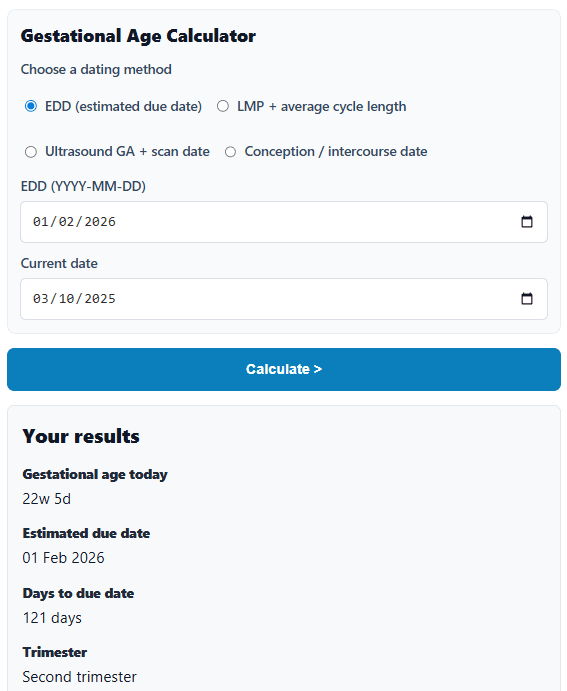
- Select one input: EDD, LMP + average cycle length, Ultrasound GA + scan date, or Conception date.
- See gestational age on that date (weeks+days), days to due date, and the trimester.
If methods disagree, ultrasound dating in early pregnancy is often preferred for accuracy. For IVF/FET, use the transfer option in the IVF calculator.
Methodology & sources
How this calculator works
This tool estimates gestational age today, the estimated due date, and the trimester. It follows standard obstetric dating conventions described in the sources below.
Primary dating methods
- EDD known: If you already have an EDD (for example from a prior clinical visit), the tool infers the last menstrual period date by counting back 280 days, then counts forward to today.
- LMP + average cycle length: Naegele’s rule assumes a 28 day cycle with ovulation about day 14. If the reported average cycle differs, the LMP to ovulation interval is shifted by the difference from 28 days. EDD = adjusted LMP + 280 days.
- Ultrasound GA + scan date: If an ultrasound reported GA (weeks + days) on a scan date, the tool derives the EDD from that GA, then computes GA today. Early ultrasound is generally preferred over LMP when they disagree meaningfully.
- Conception date: For approximate dating, LMP is estimated as 14 days before conception, then EDD = LMP + 280 days.
What we show
- Gestational age today in weeks and days.
- Days to due date.
- Trimester label using common bands: first 0–13w 6d, second 14–27w 6d, third 28w+.
Assumptions and guardrails
- Dates are treated as whole calendar days in local time. Future dates are allowed for planning and are labelled as hypothetical.
- Cycle length adjustment is a practical heuristic. Irregular cycles, assisted reproduction, or uncertain dates may need clinician review.
- When both LMP and early ultrasound exist and disagree, early ultrasound dating is usually preferred.
- American College of Obstetricians and Gynecologists. Methods for Estimating the Due Date (Committee Opinion No. 700). acog.org
- American College of Obstetricians and Gynecologists. How Your Fetus Grows During Pregnancy. acog.org
- NHS. Pregnancy due date calculator. nhs.uk
- Pregnancy, Birth and Baby. Dating scan. pregnancybirthbaby.org.au
- American College of Obstetricians and Gynecologists. Abnormal Uterine Bleeding. acog.org
Math behind the calculator
- Starting from a due date (EDD): count back 280 days to find the notional “start” of pregnancy (the LMP date). Gestational age is how many days have passed from that start to today.
- Starting from LMP + cycle length: if your average cycle is not 28 days, shift the LMP by the difference. Example: 31-day cycles shift forward 3 days, 25-day cycles shift back 3 days. The due date is 280 days after this adjusted LMP. Gestational age is the time from the adjusted LMP to today.
- Starting from an ultrasound report: the scan tells you how far along you were on the scan day. To get gestational age today, add the calendar-day difference between the scan date and today to the reported age. From that we also show a due date based on a 280-day pregnancy length.
- Starting from a conception date: conception is assumed to be about two weeks after the LMP. We go back 14 days from the conception date to set the LMP, then work out gestational age and the due date from there.
- Weeks and days: we turn total days into whole weeks plus the leftover days. Example: 87 days = 12 weeks 3 days.
- Days to due date: we count calendar days from today to the due date. If the due date has passed, the result shows how many days overdue it is.
- Trimester labels: First trimester ends at 13 weeks 6 days. Second trimester runs from 14 weeks to 27 weeks 6 days. Third trimester starts at 28 weeks.
- End of 1st trimester (date): this is 13 weeks 6 days after the LMP.
- Date handling: we treat dates at local midnight to avoid off-by-one shifts from time of day or daylight saving changes.
If methods disagree, early ultrasound dating is usually the most accurate. For IVF or FET pregnancies, use our IVF/FET due date tools for transfer-based dating.
Frequently asked questions
Which input is most accurate for GA?
First-trimester ultrasound dating is usually the most accurate. If you have a scan-based gestational age, use that option. Otherwise, use LMP, a confirmed due date, or a known conception date.
How do I calculate GA from EDD?
Enter your EDD. The tool counts backward to show how many weeks and days pregnant you are today. If your EDD came from a scan, results reflect that dating.
How do I use LMP if my cycles aren’t 28 days?
Add your average cycle length so ovulation is adjusted from day 14. If your cycles vary a lot, compare results with the Pregnancy Due Date Calculator or an early ultrasound.
Can I calculate GA from an ultrasound report?
Yes. Enter the ultrasound GA and the scan date. The tool projects that dating to today and shows the trimester and days to EDD.
What if I know the conception date?
Use the conception-date option to estimate gestational age and EDD. If you only know an intercourse date, use the Due Date From Intercourse or Conception Calculator, because intercourse and conception may occur on different days (ASRM guidance).
How are trimesters labeled?
Commonly: First (0–13w6d), Second (14–27w6d), Third (28w0d+). Some clinics use slightly different cutoffs; your provider’s guidance applies.
IVF/FET: should I use this or the IVF calculator?
Use the IVF/FET Due Date Calculator for transfer-based dating (Day 3/5/6). It returns GA today and EDD using embryo age at transfer.